Linear algebra, one idea a morning

8 of 40 lessons out so far. A new one lands every morning by 8 am Pacific.
Watch day 82:34

Elementary matrices and computing inverses

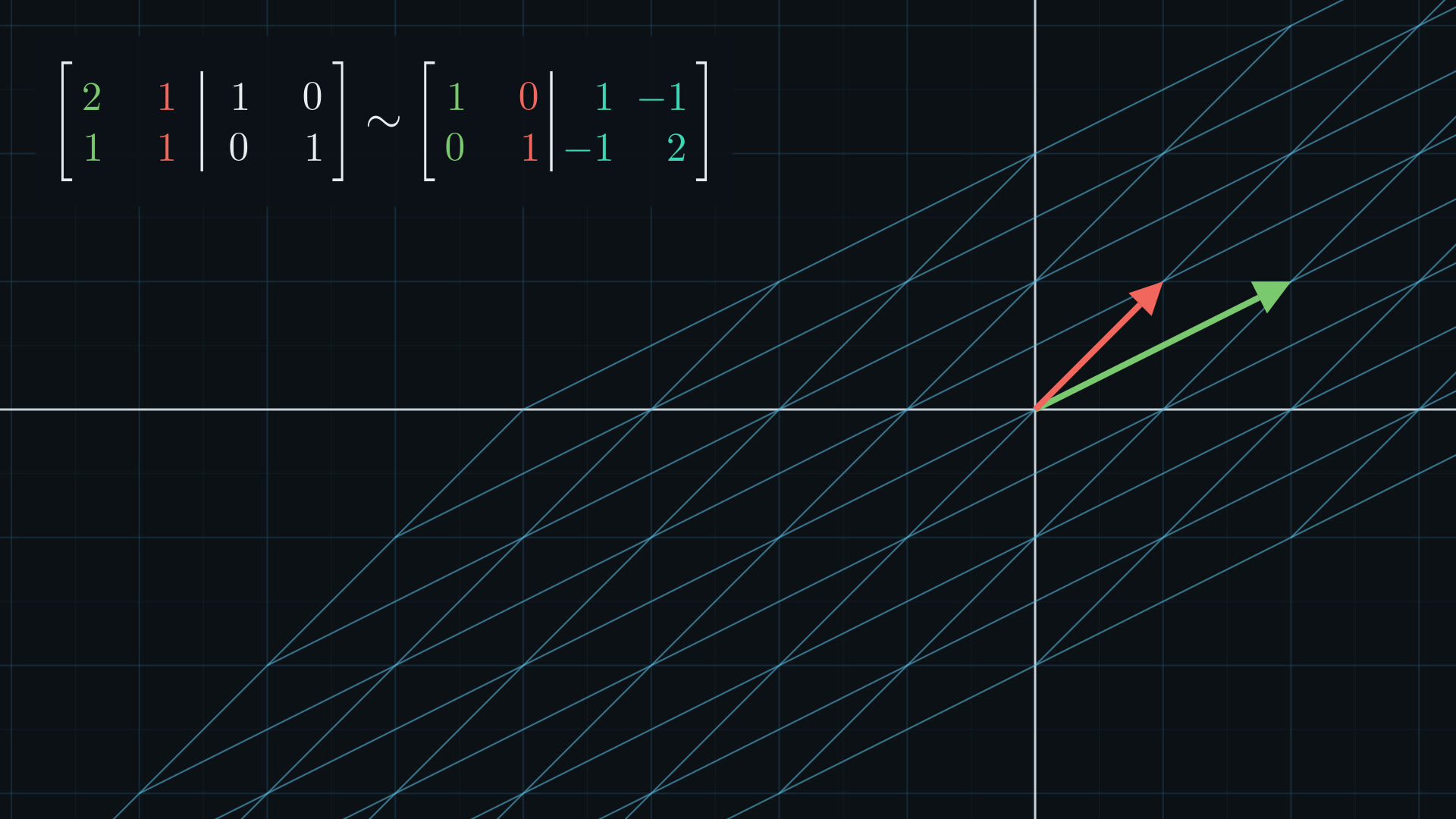
Every row operation is multiplication by an elementary matrix, so row-reducing A to I builds A⁻¹ along the way.

Foundations
  1. Day 1, 1:58

    Vectors

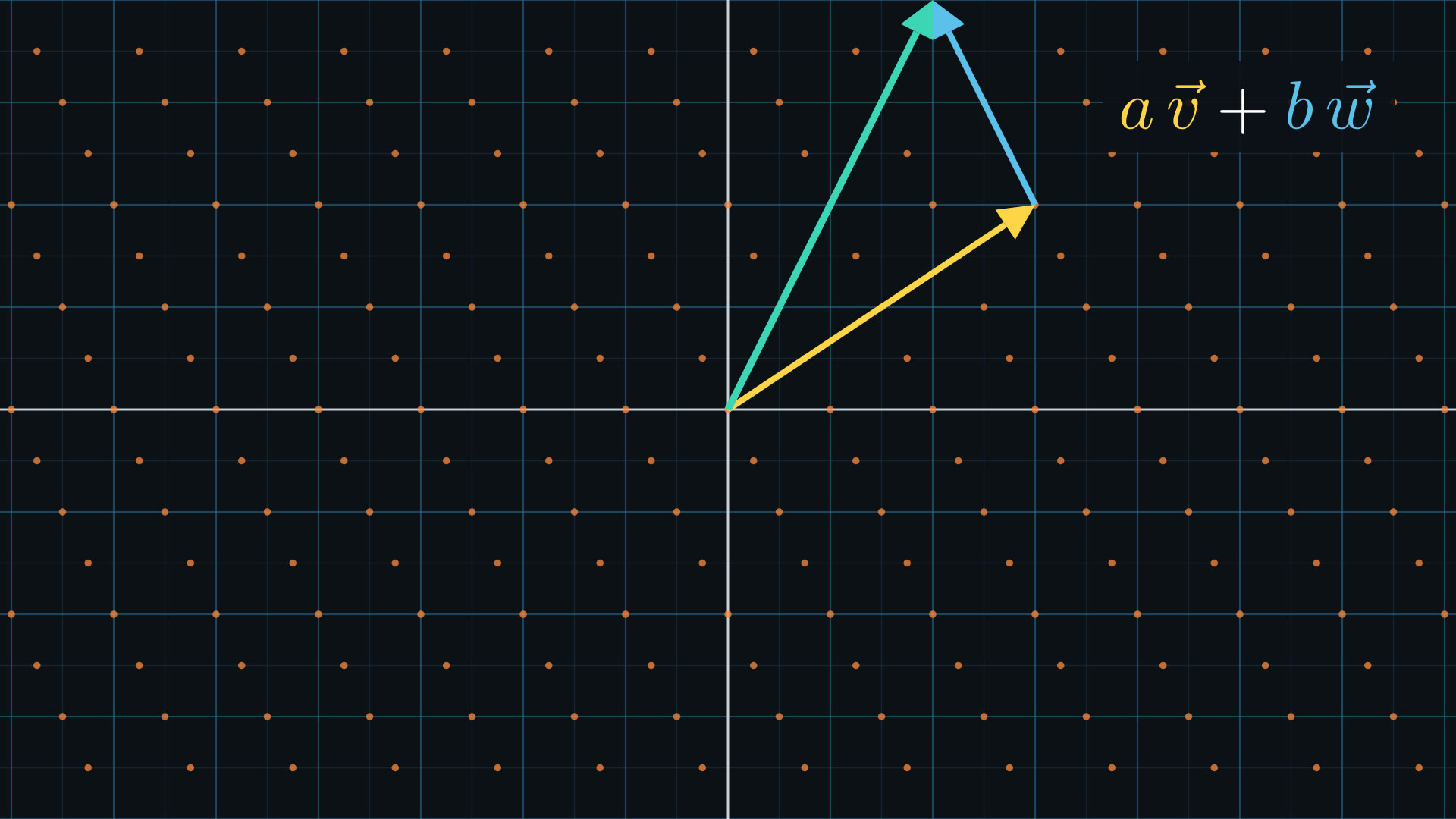
    A vector is an arrow from the origin and a list of numbers at the same time; adding and scaling mean the same thing in both pictures.

  2. Day 2, 2:32

    Linear combinations and span

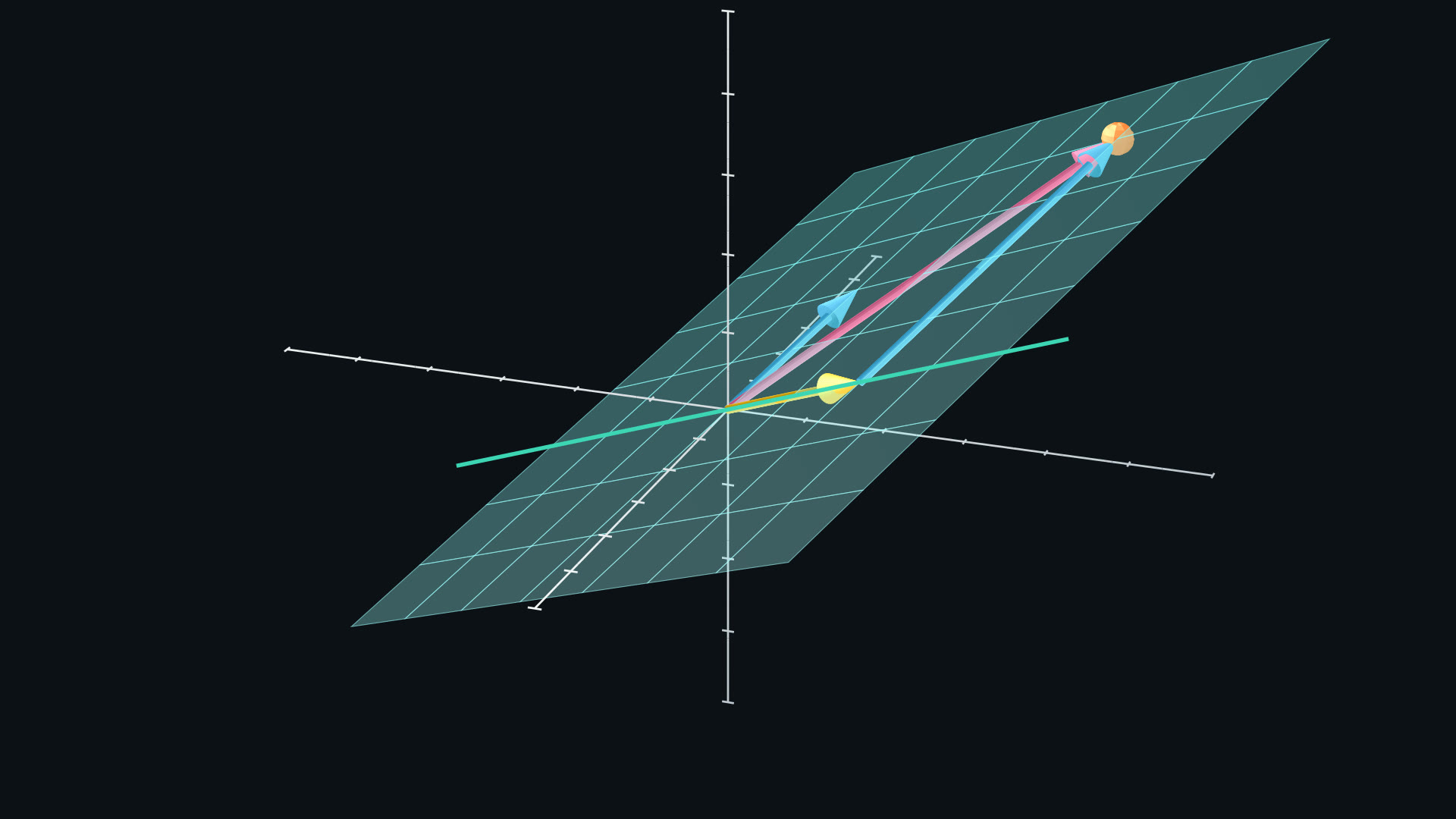
    The span of some vectors is every place you can reach by scaling and adding them.

  3. Day 3, 2:45

    Systems of equations and row reduction

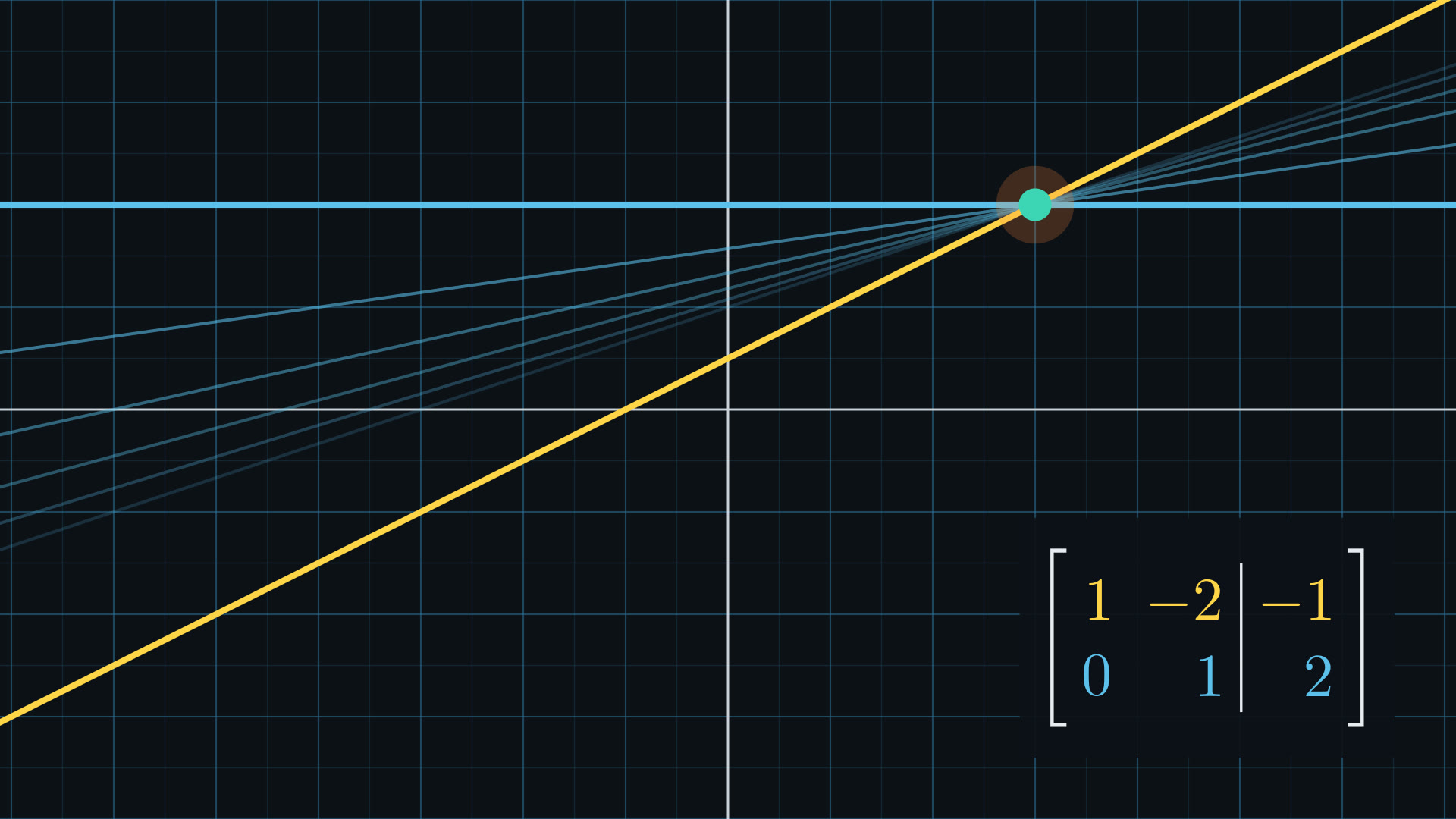
    Row operations change the equations without changing the solution set, so we simplify until the answer is readable.

  4. Day 4, 2:28

    Matrix times vector

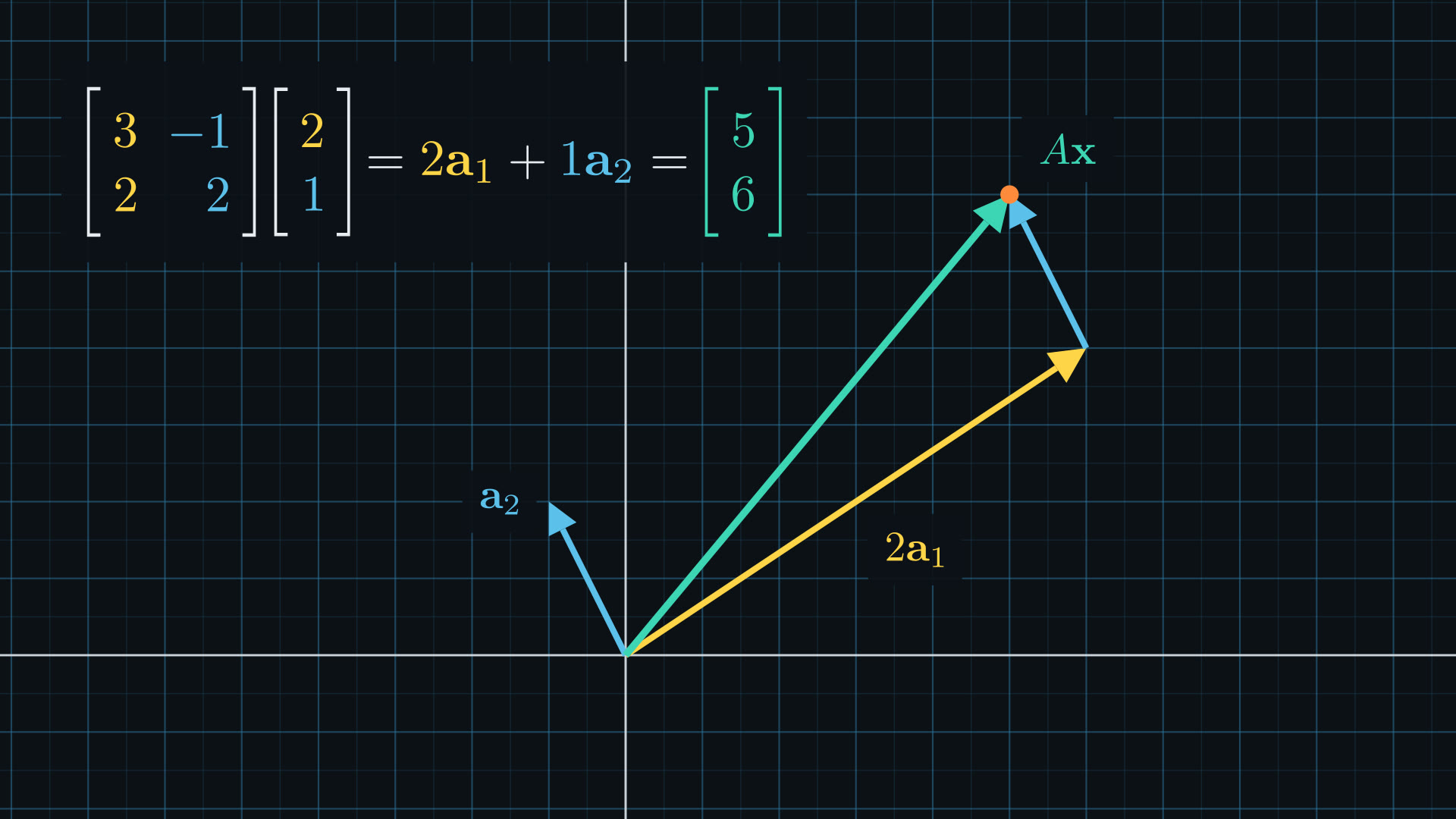
    Ax is a linear combination of the columns of A, using the entries of x as the weights.

  5. Day 5, 2:21

    Matrices are transformations

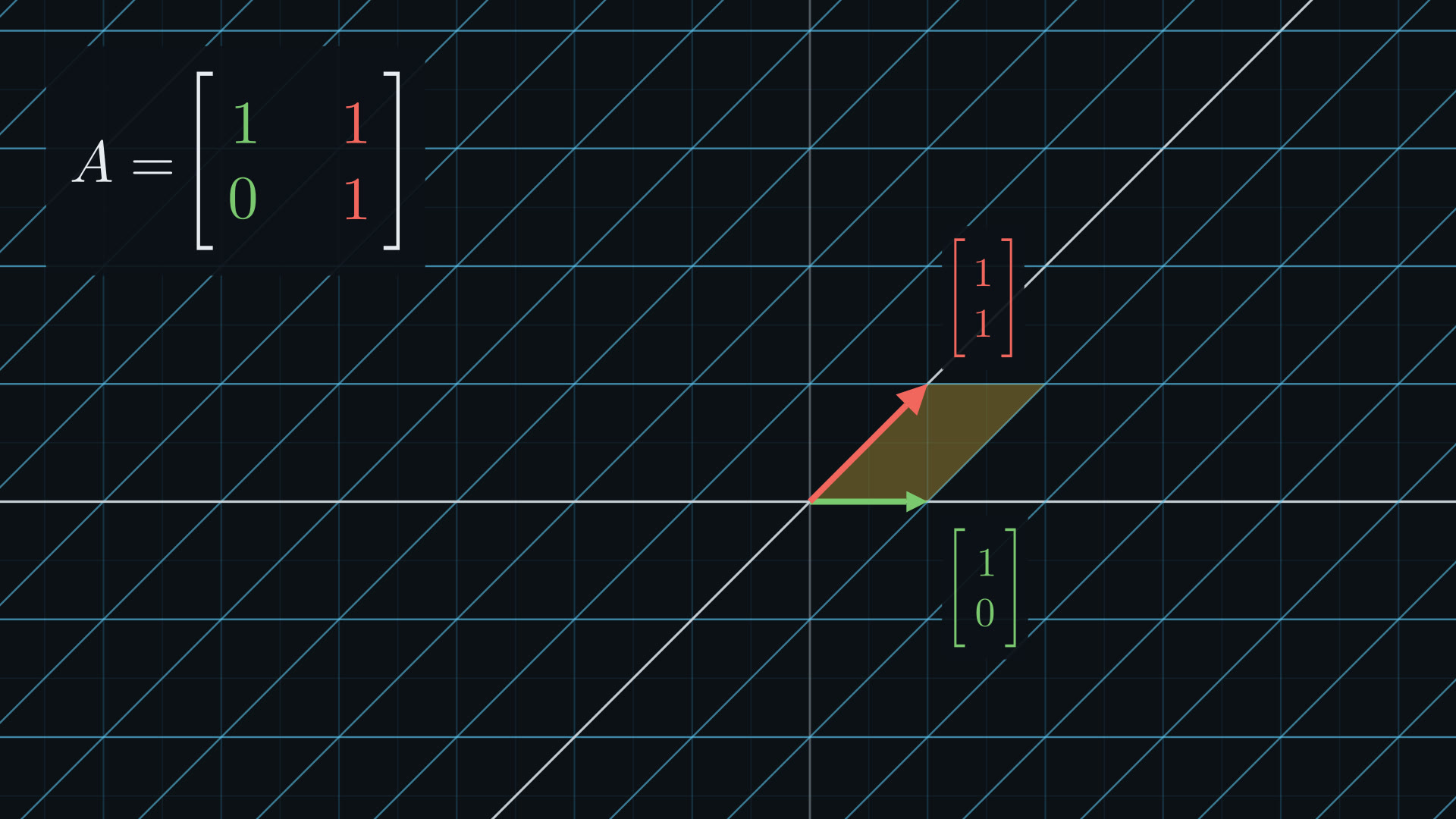
    A matrix moves every point of the plane, and its columns record where the two basis arrows land.

  6. Day 6, 2:30

    Matrix multiplication is composition

    AB means do B first, then A; the product's columns are A applied to B's columns.

Matrix algebra

  1. Day 7, 2:31

    The inverse of a matrix

    A⁻¹ is the transformation that undoes A, and it exists exactly when A doesn't squash space flat.

  2. Day 8, 2:34

    Elementary matrices and computing inverses

    Every row operation is multiplication by an elementary matrix, so row-reducing A to I builds A⁻¹ along the way.

  3. Day 9

    LU decomposition

    A = LU records elimination once, so solving Ax = b for many right-hand sides becomes two quick triangular solves.

Vector spaces

  1. Day 10

    What is a vector space?

    Anything you can add and scale by the usual rules is a vector space, including polynomials, functions and matrices.

  2. Day 11

    Subspaces

    A subspace is a flat piece through the origin that you can never leave by adding or scaling.

  3. Day 12

    Span as the smallest subspace

    Span{v1,…,vp} is the smallest subspace containing those vectors, and a spanning set is a recipe for the whole space.

  4. Day 13

    Linear independence

    Vectors are independent when none of them is redundant, meaning the only way to combine them to 0 is with all weights 0.

  5. Day 14

    Basis

    A basis spans the space with no redundancy, so every vector has exactly one address in it.

  6. Day 15

    Coordinates and dimension

    Every basis of a space has the same size, and that number is the dimension.

  7. Day 16

    Column space and row space

    The column space is everything A can output; its pivot columns form a basis.

  8. Day 17

    Null space

    The null space is every input that A crushes to zero, and it is always a subspace.

  9. Day 18

    Rank and nullity

    Every input dimension either survives into the output or gets crushed: rank + nullity = number of columns.

  10. Day 19

    The invertible matrix theorem

    For a square matrix, a dozen different-sounding conditions are all the same fact: A doesn't squash any direction.

Linear transformations

  1. Day 20

    Linear transformations between vector spaces

    A linear transformation is any map that respects adding and scaling, and that includes differentiation.

  2. Day 21

    The matrix of a linear transformation

    Pick a basis for each side and any linear map becomes a matrix; column j is where basis vector j lands, in coordinates.

  3. Day 22

    Change of basis

    A change-of-basis matrix translates coordinates from one grid's language to another's without moving the vector.

  4. Day 23

    Kernel

    The kernel is everything T sends to zero, and T is one-to-one exactly when the kernel is only zero.

  5. Day 24

    Image (range)

    The image is every output T can make; the rank-nullity theorem splits the input dimension between kernel and image.

Determinants

  1. Day 25

    The determinant measures area

    det A is the factor by which A scales areas (volumes in 3D), with a sign that says whether orientation flips.

  2. Day 26

    Computing determinants

    Cofactor expansion computes any determinant, and row operations change it in three predictable ways.

  3. Day 27

    Determinant properties and Cramer's rule

    Because det is linear in each row and flips sign on swaps, it follows the rules that make det(AB) = det(A)det(B) and Cramer's rule work.

Eigenvalues

  1. Day 28

    Eigenvectors and eigenvalues

    An eigenvector is a direction A only stretches, never turns: Av = λv.

  2. Day 29

    Finding eigenvalues

    λ is an eigenvalue exactly when A − λI squashes space, so we solve det(A − λI) = 0.

  3. Day 30

    Properties of eigenvalues

    Eigenvalues tell you trace, determinant and what powers of A do.

  4. Day 31

    Generalized eigenvectors

    When there aren't enough eigenvectors, a chain of generalized eigenvectors fills the gap: (A − λI) pushes each one down the chain.

  5. Day 32

    Diagonalization

    If you have enough eigenvectors to make a basis, A = PDP⁻¹, and in that basis A just scales each axis.

  6. Day 33

    Diagonalizing a linear transformation

    Choosing an eigenvector basis makes the matrix of a linear transformation diagonal.

  7. Day 34

    Symmetric matrices and the spectral theorem

    Symmetric matrices always have real eigenvalues and perpendicular eigenvectors, so they are rotations of pure stretches.

Special topics

  1. Day 35

    Dot products and orthogonality

    The dot product measures how much two vectors point the same way; zero means perpendicular.

  2. Day 36

    Orthogonal projection

    Projecting onto a subspace finds its closest point, and the leftover piece is perpendicular to the subspace.

  3. Day 37

    Gram–Schmidt

    Gram–Schmidt straightens any basis into a perpendicular one by subtracting off shadows one vector at a time.

  4. Day 38

    Least squares

    When Ax = b has no solution, project b onto Col A and solve that instead: AᵀAx = Aᵀb.

  5. Day 39

    Quadratic forms

    xᵀAx describes bowls, saddles and ridges, and the eigenvalues of A tell you which one you have.

  6. Day 40

    The singular value decomposition

    Every matrix is a rotation, then a stretch along the axes, then another rotation: A = UΣVᵀ.